
The Tyndall National Institute is a global leader in semiconductor innovation, driving breakthroughs in micro-nanoelectronics and integrated photonics. By bridging the gap between pioneering research and industrial application, they drive research excellence in emerging materials and devices, next-generation chip design, quantum hardware, and smart sensors.
Project Background
In partnership with University College Cork, the Science Foundation of Ireland (SFI) and the Irish Department of Enterprise Trade and Employment, Tyndall and University College Cork are expanding their existing world-class facilities to accommodate a doubling in size of TNI over the next ten years. The proposed new facility will cater for up 250 post-graduate students and 750 staff. This ambitious plan will continue to position Ireland at the heart of the global semiconductor ecosystem.
Following Scott Tallon Walker Architects Masterplan for the North Mall site in the old Distillery Quarter of Cork, a site was located for the development of a new 17,500m² state-of-the-art building, directly across the North channel of the River Lee from Tyndall’s existing facilities. In time, both sides will be connected by a pedestrian bridge.
The new facility contains an overlapping and collaborative mix of Packaging & Integration, Bio-Photonics, Advanced Manufacturing/ FMID, Quantum Research, Med-Tech and Climate & Energy Research Labs including Clean Rooms and an Ultra Low Level Vibration Microscopy Suite. It will also accommodate Education and Public Engagement (EPE) Programmes, Outreach & Incubation spaces, Electronic Test Labs and a variety of workplace environments, break-out, and social interaction spaces.
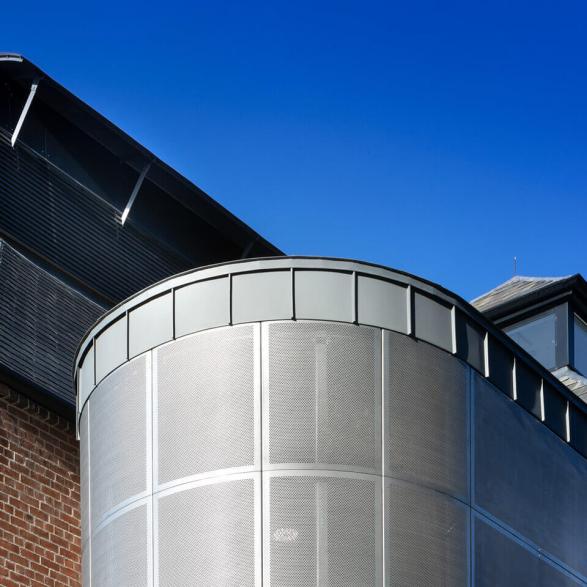
Cognisant of the site’s rich Architectural Heritage, the new building will restore and integrate elements of the former 1960’s Cork Distilleries Bottling Plant, designed by well-known Cork Architect Frank Murphy.
The TNI expansion is based on the express requirement of Government to upgrade and expand the Institute’s world-leading capabilities and expertise in cutting edge, state-of-the-art research. This has been explicitly referenced in the Governments Project 2040, National Development Plan 2018-2027 as well as within the subsequent DBEI document Investing in Business, Enterprise and Innovation 2018-2027. This investment will position the TNI as an international leader of scale in translational research in order to play a key role in the further development of ICT innovation and impact in Ireland.


Client and End User Engagement Process
Scott Tallon Walker Architects led a number of early visioning sessions with the end user groups, FM Teams and Integrated Leadership Team to establish a set of key Design Objectives. During the workshops, particular emphasis was placed on enhancing Tyndall’s public engagement and opening up the facility and campus to the wider community.
The outcome was agreement that the new building should reflect a highly interactive and collaborative environment, underpinned by the following basic principles.

Architecture
This project presents an opportunity to strengthen Tyndall’s reputation for producing ground-breaking science. The building is envisaged as a facilitator for research and collaboration, interweaving a network of people and ideas with an adaptable palette of workplace environments. It fosters a community, both local and international, that is dynamically linked to place and the wider world.
The concept for the new building can be explained through a series of key ideas:
1. Physical response to place: Maximising its connection with the industrial heritage of the site and its proximity to the city of Cork.
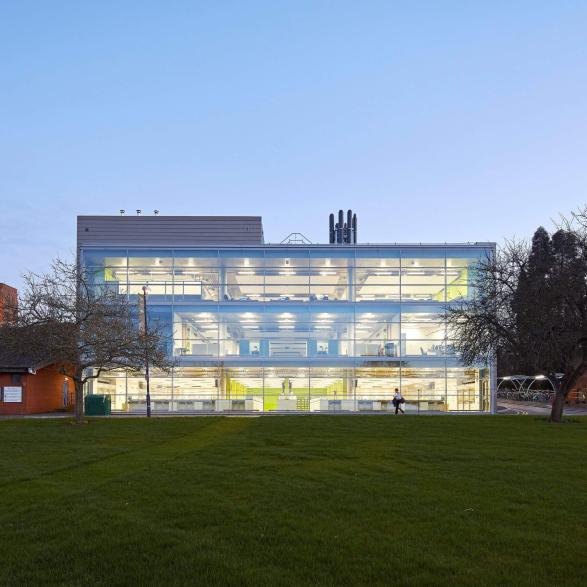
2. Overlapping spaces: The organisational plan has been laid out to facilitate a range of research type space. All activity is organised in a figure of eight, with two central atria that allow visibility and physical connectivity between different groups. The open voids work in plan and section, creating a weave like structure that allows for multiple groups to work in collaboration, while maintaining a degree of privacy and independence to secure intellectual property.
3. Social Science: Modern science can be described as an intensely social activity where scientists are intimately familiar with both the substance and style of each other’s work. Therefore, the design of the building facilitates both structured and informal interaction, flexible use of space, and sharing of resources.
4. Intelligent structuring: The building will be characterized by the presence of a digital infrastructure robust enough to collect and amass building operational data; provide connectivity needed to analyse, learn from it and share it; and ultimately leverage it for the benefit of all stakeholders.
5. Inward/ Outward: A central tenant of the feedback from Tyndall staff was that the new facility should promote more engagement with the public. As a result, the design must balance the needs for social interaction with the need for quiet space to think and create.

Engineering & Sustainability
Tyndall National Institute’s new Tyndall North Facility will be delivered to BREEAM Excellent. A comprehensive Environmental Impact Assessment Report (EIAR) has been produced to set out the results of environmental assessments which were completed to inform the planning consent process. The EIAR addresses all aspects of environmental impact including: